The most accepted theory regarding Snowball Earth cites a decrease in greenhouse gas levels in Earth’s atmosphere as its cause. Greenhouse gases are gases that warm the Earth by absorbing the sun's heat; they include carbon dioxide and methane. For one, carbon dioxide levels dropped due to the weathering of silicate rocks that make up Earth's continents, which absorbed CO2 that was present in acid rain. This process occurred faster than usual because of Earth’s exceedingly high temperatures at the time, which caused silicate weathering to occur faster[6].
Furthermore, the amount of methane in the atmosphere also decreased. The atmosphere's quantity of methane is inversely related to the oxygen quantity and when the amount of oxygen increased shortly before the formation of Snowball Earth, the planet saw a decrease in methane levels. Although an exact reason is not yet known, scientists hypothesize that this occurred due to an increase in oxygenic photosynthesis.
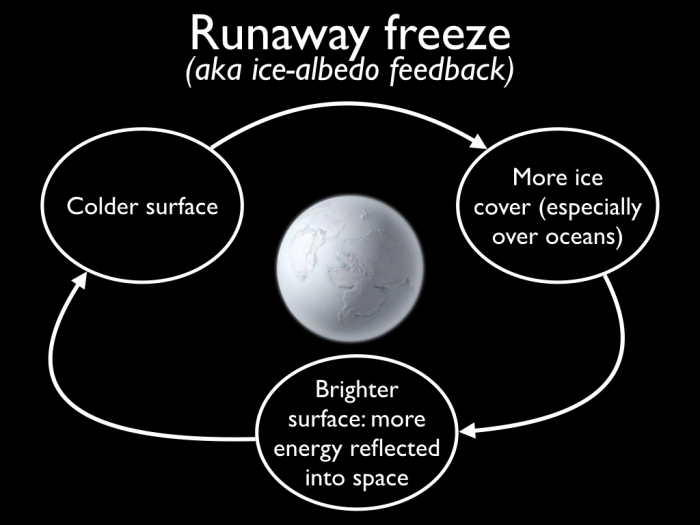
Finally, a positive ice-albedo feedback loop would follow as the newly formed ice that covered Earth would reflect sunlight back into space, thereby further lowering temperatures and prompting more glaciation[2].
However, a new theory proposes that Earth passed through a space cloud that covered it in ice, leading to Snowball Earth. Proponents of this theory argue that the passing of the cloud would have resulted in the destruction of the ozone layer. This, combined with the fact that the space dust did not permit much light to pass through to the Earth’s surface, would prompt glaciation.
Opponents of this theory state that the solar system would take 500,000 years to pass through such a space cloud. In this period of time, Earth’s magnetic field would reverse, leading to increased solar radiation that would end the Snowball Earth period[2].